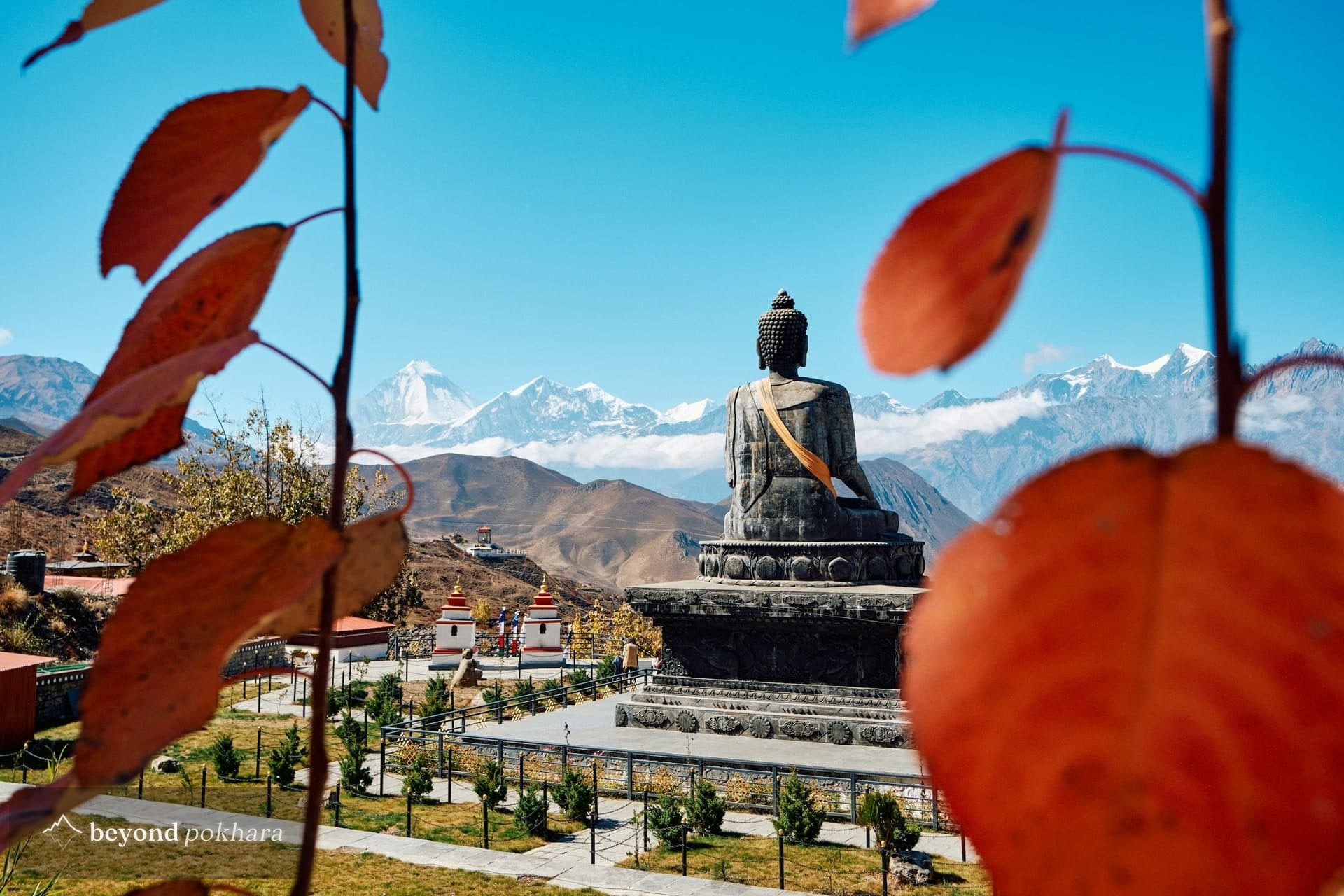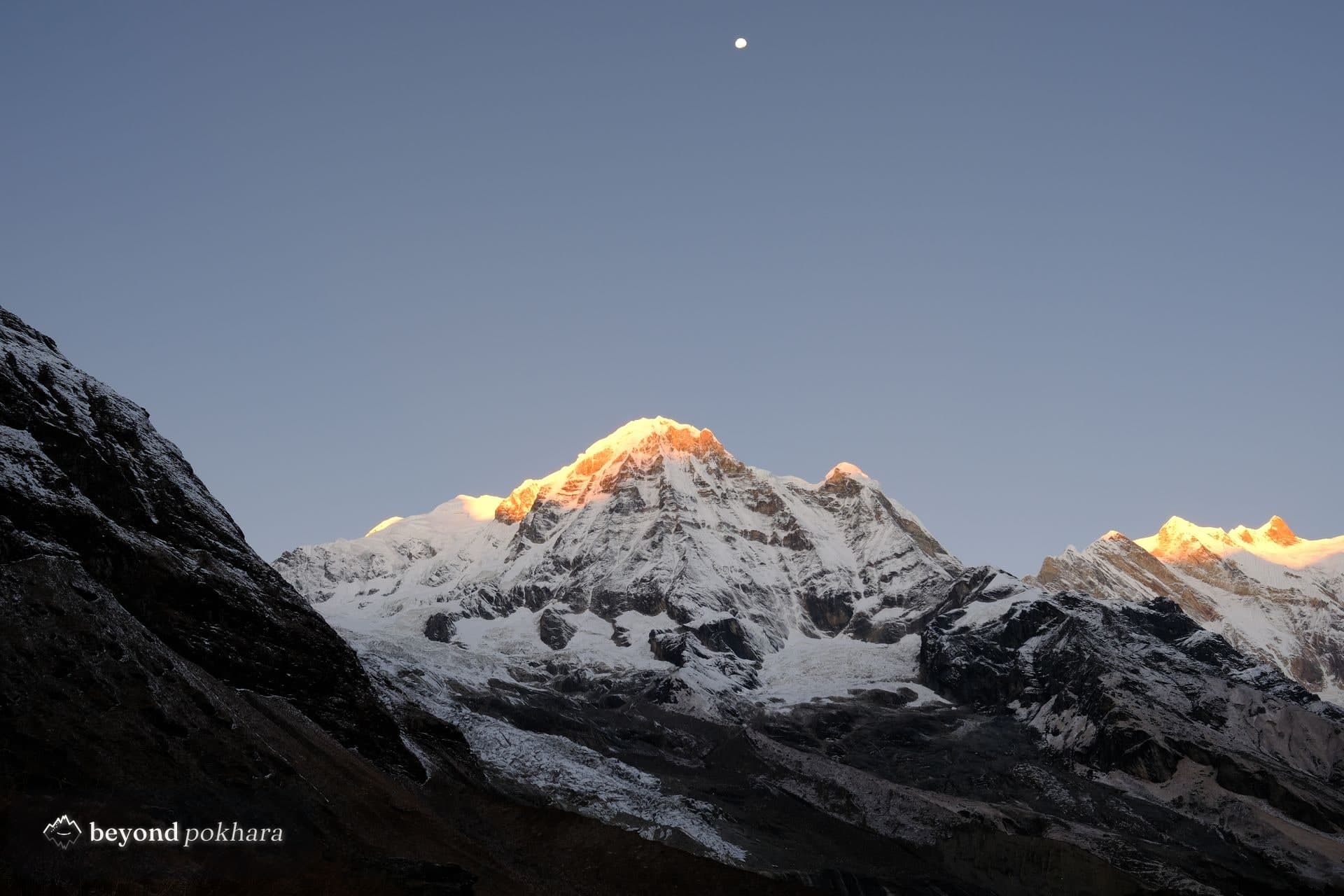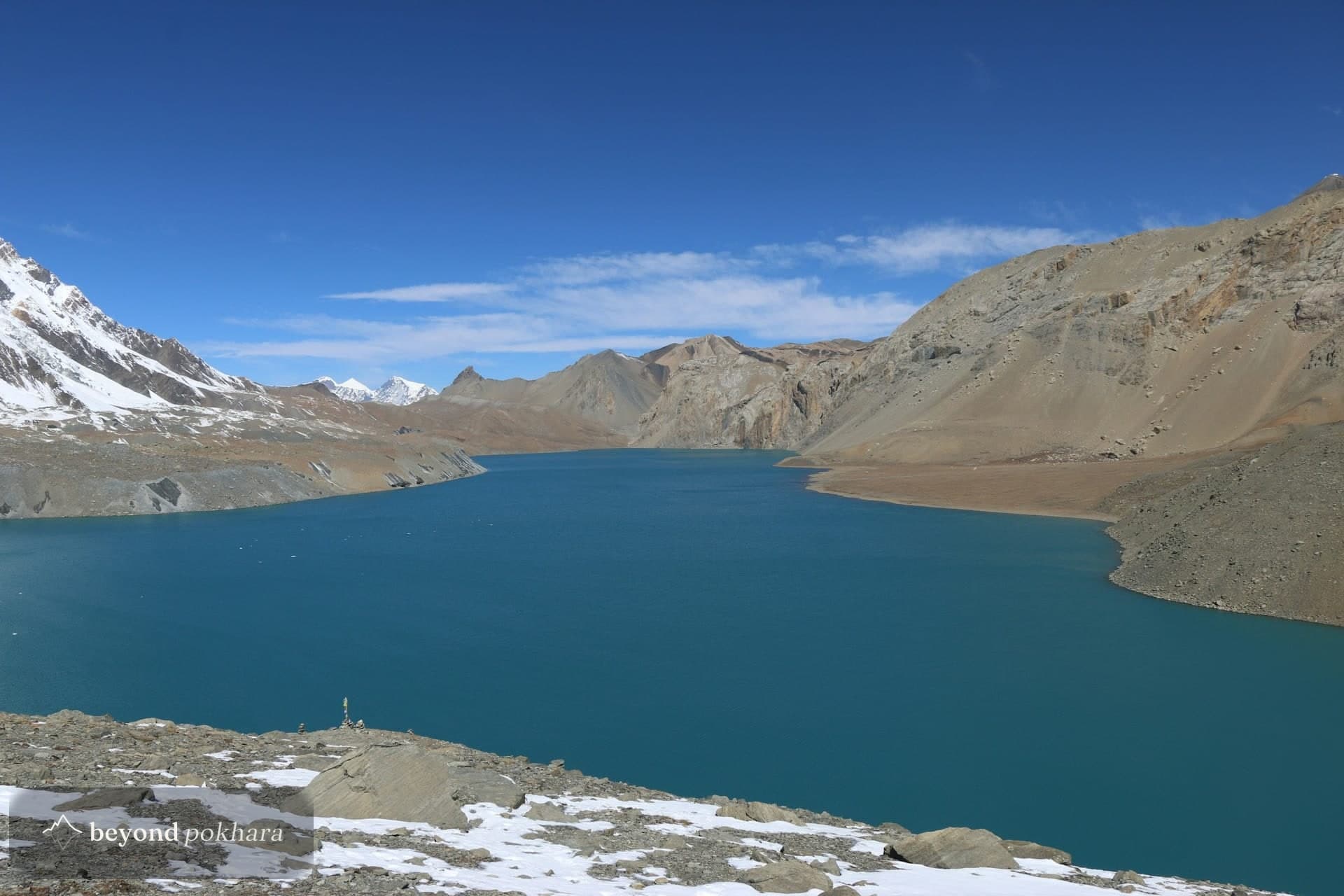
The Tilicho Lake trek from Pokhara takes you to a turquoise lake at 4,919 m below the north face of the Annapurnas, as a detour off the Annapurna Circuit above Manang. Most people do it in 10 to 14 days. You drive from Pokhara up the Marsyangdi valley, walk from Manang to Tilicho Base Camp, climb to the lake at dawn, and then either cross the Thorong La to Muktinath or come back down the same valley. It is a harder walk than the standard Circuit, and a flood this autumn changed what can drive up to Manang.
Where Tilicho Lake is
The lake lies west of Manang, under Tilicho Peak (7,134 m), roughly 4 km long and just over 1 km wide, and it freezes over in winter. Plenty of sites call it "the highest lake in the world", which is wrong: there are higher lakes in the Andes, and Kajin Sara, also in Manang district, sits above 5,000 m. Tilicho is better described as one of the highest large lakes a trekker can walk to.
Khangsar is the last village before the lake. From there the trail turns off the Circuit and runs along the slope above the Khangsar Khola to a cluster of lodges at Tilicho Base Camp, around 4,150 m.
Tilicho Lake trek route from Pokhara
Our Tilicho Lake trek runs in this order:
- Day 1: Pokhara to Chame by road, up the Marsyangdi valley.
- Days 2 and 3: walk Chame to Pisang, then over the high route through Ghyaru and Ngawal to Manang (3,540 m).
- Day 4: a short day to Khangsar (3,750 m), which helps with acclimatisation.
- Day 5: Khangsar to Tilicho Base Camp across the landslide section.
- Day 6: up to the lake before sunrise, then back to Shree Kharka.
- Days 7 to 9: Yak Kharka, Thorong Phedi, then the Thorong La at 5,416 m and down to Muktinath.
- Day 10: Jomsom to Pokhara by road or on the morning flight.
That is ten days with no slack. We build in two to four spare days, one for an extra night in Manang and the rest for weather, which is why the trip is listed at 14 days.
If you don't want the pass, there is a shorter shape. The road now goes past Manang to Khangsar, so you can drive most of the way, walk Khangsar to base camp and the lake, and come back the same way. That makes it about a week from Pokhara. It skips the Thorong La but leaves you less time to acclimatise, so the extra night in Manang becomes more important.
The road to Manang in late 2026
From Pokhara to Besisahar the road is paved. From Besisahar to Chame it is a rough mountain road, and above Chame it is an improved track that now reaches Khangsar. In July 2026 landslides at Kharkhare and Hawadanda closed the Besisahar to Chame stretch for three days.
The bigger change came in late September, when floods put the main road bridge at Chame under water. The road to upper Manang was closed for three weeks. It reopened on 14 October over a temporary wooden crossing that takes only light vehicles, so trucks and buses still stop below Chame. Before you fix dates, check that the crossing is still open or that the new bridge is in, and keep a spare day at the start of the trek in case the road closes again.
The landslide section
The day from Khangsar (or Shree Kharka) to base camp is the reason this trek is graded challenging. The trail crosses a long slope of loose scree and rubble, with a steep drop to the river. In places it is a narrow path cut into moving ground. Rockfall is most likely once the sun warms the slope, so leave Khangsar early, by 7 in the morning, and cross without stopping in the open sections.
The lake day starts in the dark. From base camp it is a climb of roughly 800 m to the shore, usually three to four hours up, then the whole way back down to sleep lower. The usual reason people turn back is the altitude. If you have a headache that won't shift or you feel sick at base camp, don't go up.
Permits and the guide rule
Tilicho is inside the Annapurna Conservation Area, so you need two permits:
- ACAP (Annapurna Conservation Area Permit): NPR 3,000, about 22 US dollars.
- TIMS card: NPR 2,000, about 15 US dollars.
Since April 2023, foreign trekkers on Annapurna routes must walk with a licensed guide. That makes a guide a fixed cost whether you book a trip or arrange everything yourself. Get both permits in Pokhara before you set off, because buying them at a checkpoint costs double.
Tilicho Lake trek cost
For one trekker arranging it independently over ten days, the main costs are:
- Licensed guide: about 30 to 35 US dollars a day, so 300 to 350 for the trek.
- Porter (optional): about 20 to 25 US dollars a day, often shared between two.
- Permits: about 37 US dollars.
- Teahouse rooms: cheap in the villages, more expensive and basic higher up. Base camp and Thorong Phedi are the priciest nights.
- Food: 25 to 40 US dollars a day. Food costs more above Manang because everything is carried up.
- Transport: the road in from Pokhara, and back from Jomsom by road or by the morning flight, about 160 to 180 US dollars one way.
Our trip starts from 949 US dollars per person, confirmed when you book. That covers the licensed guide, private transport from Pokhara to the trailhead and back, teahouse rooms, the ACAP permit and TIMS card, and government taxes. Meals, insurance, a porter and tips are extra. Your travel insurance needs to cover trekking up to 5,500 m. Our travel insurance for Nepal trekking guide explains what to check.
When to go
The two good windows are October to November and March to May. Autumn has the clearest air, and the lake is at its bluest. In spring it is warmer, with more snow left on the peaks, and the lake can still be frozen at the edges in March.
From December to February the lake freezes over. Snow sits on the landslide traverse, which makes a dangerous section worse, and the Thorong La is often snowbound. From June to September the monsoon brings landslides on the road and on the trail, though Manang gets less rain than the lower valley. If you are reading this in November, the next good window is March, and the winter months are when to fix dates and book a guide.
Tilicho or the standard Circuit
If you have already decided on the Annapurna Circuit, Tilicho adds two or three days and the hardest single day of the trip. Besides the lake, the practical gain is acclimatisation: you reach the Thorong La having already slept above 4,000 m, and the trail above Khangsar is quieter than the main Circuit.
If the landslide section worries you, or you have under two weeks, the Annapurna Circuit trek without the side trip is the easier choice. For something shorter from Pokhara, see our list of the best short treks from Pokhara. Once you are over the pass, Muktinath and Jomsom are the same towns covered in our Pokhara to Muktinath guide.
Doing it with us
We run the Tilicho Lake trek from Pokhara for groups of two to eight, with a licensed guide, transport to the trailhead and the permits arranged before you arrive. We plan the days around your fitness and how much time you have. That includes how much of the lower valley you drive, whether you cross the Thorong La or come back from the lake, and where you take the spare days. Tell us your dates and plan the Tilicho Lake trek with us, or browse our other treks from Pokhara.
FAQ
How many days is the Tilicho Lake trek from Pokhara?
About 10 days if you drive to Chame, walk to the lake, cross the Thorong La and come back from Jomsom. Plan 12 to 14 so you have spare days for weather and acclimatisation. A shorter out-and-back from Manang, without the pass, takes about a week.
Is Tilicho Lake the highest lake in the world?
No. It sits at 4,919 m and is often described as one of the highest lakes of its size, but there are higher lakes in the Andes and in Nepal itself, including Kajin Sara in Manang. It is still one of the highest lakes most trekkers can walk to.
How hard is the Tilicho Lake trek?
It is harder than the standard Annapurna Circuit. The trail from Khangsar to base camp crosses an exposed landslide slope, the climb to the lake gains about 800 m above 4,000 m, and the full version adds the Thorong La at 5,416 m. You need good fitness and time to acclimatise, not climbing skills.
Can I do the Tilicho Lake trek in winter?
December to February is the hardest time. The lake freezes, snow covers the landslide traverse and the Thorong La is often snowbound. Most people should plan for March to May or October to November instead.