Pokhara to Muktinath by jeep is a drive of roughly 190 km up the Kali Gandaki valley, through Beni and Jomsom, to a temple at about 3,710 m that Hindus and Buddhists across Nepal and India treat as sacred. The first day takes you from Pokhara to Jomsom in eight to nine hours, and the climb from Jomsom to Muktinath adds another hour and a half to two. Most people do the round trip in three days, and a private 4WD jeep with a driver starts around 110 US dollars a day.
The route from Pokhara to Muktinath by jeep
You leave Pokhara heading west to Baglung and Beni, where the Kali Gandaki comes out of the mountains. Up to Beni the road is busy but manageable in an ordinary car. After Beni it becomes a dirt road up the gorge, and from there you need a 4WD. The road climbs past Tatopani and its hot springs, through Ghasa and Lete, and into the gap between Dhaulagiri and the Annapurnas, which is why the Kali Gandaki is often called the deepest gorge on earth.
Above Ghasa the forest thins and the valley turns dry and wide. You pass Tukuche and the apple orchards of Marpha before reaching Jomsom at 2,720 m, the district headquarters and the usual first night. From Jomsom the road follows the river to Eklebhatti, where a short detour leads to the old village of Kagbeni, then climbs past Jharkot to Ranipauwa, the small town at the foot of the temple. Pokhara to Jomsom is about 160 to 170 km. Jomsom to Muktinath is roughly another 20.
How many days you need
Three days is the shortest round trip that is still pleasant, and it is the shape our trip follows:
- Day 1: Pokhara to Jomsom, eight to nine hours on the road.
- Day 2: Jomsom up to Muktinath for the morning, then back down to Marpha for the night.
- Day 3: Marpha to Pokhara, another long day down the gorge.
With four or five days the trip gets easier on the body. A night in Kagbeni is the best use of a spare day, and the hot springs at Tatopani make a good stop on the way down. The roads are rough, and two eight-hour days back to back wear out even the passengers.
Plan the altitude carefully. Pokhara sits at about 820 m, and Muktinath is more than 3,000 m higher. Coming down to sleep in Jomsom or Marpha, at around 2,700 m, after your visit is much safer than spending the night in Ranipauwa next to the temple. Take the stairs to the temple slowly and drink more water than feels necessary. A headache that gets worse is the signal to go down.
What the Pokhara to Muktinath jeep fare covers
Fares for this route vary wildly online, mostly because people are comparing different things. Some quote a seat in a shared jeep, others a one-way private hire or a full trip with hotels. The cost is easier to judge in parts.
A private 4WD jeep is priced by the day. Ours starts around 110 US dollars a day, including the driver and fuel. A three-day round trip comes to roughly 330 US dollars for the jeep, which seats up to six. In a full jeep that is about 55 dollars each for the transport. A one-way private hire usually still pays for the jeep's journey back to Pokhara, so it is rarely half the return price.
On top of the vehicle, everyone needs an ACAP permit for the Annapurna Conservation Area, NPR 3,000 for foreign visitors and NPR 1,000 for SAARC nationals. Jomsom, Marpha and Kagbeni have simple lodges, so budget for two nights and three days of meals.
Our Jomsom and Muktinath overland tour starts at 299 US dollars per person. That covers the private vehicle and mountain driver, a licensed guide, lodges on the route, all permits and entry fees, fuel, tolls and taxes. Meals, travel insurance, temple donations and tips are extra.
Cheaper ways up: bus, shared jeep and flight
Public buses run from Pokhara to Jomsom and take roughly as long as a jeep, eight to nine hours, on fixed departure times. From Jomsom, shared jeeps cover the last stretch to Muktinath. This costs a fraction of a private hire. The trade is cramped seats and waiting for a jeep to fill, and you cannot stop where you like.
You can also fly. The flight from Pokhara to Jomsom takes about 25 minutes and only operates in the morning, because strong winds blow up the valley by midday. Flights are often delayed or cancelled when cloud sits in the gorge, so keep a spare day. A common mix is to fly up for the views and drive back, or the reverse, with a jeep covering Jomsom to Muktinath either way.
Permits for Muktinath
Jomsom, Kagbeni and Muktinath are all inside the Annapurna Conservation Area, and an ACAP permit is checked on the way. Some checkposts also ask for a TIMS card. Checkposts are not consistent about it for road-only travel, so carry one and save yourself an argument at the barrier. You do not need the Upper Mustang restricted-area permit for this trip. That permit only applies north of Kagbeni, which is the separate Pokhara to Mustang road trip.
Fees change from time to time, so check the current rate before you go. On our trip the permits are arranged and included.
Best time to drive to Muktinath
Spring, from March to May, and autumn, from September to November, give the most reliable road and the clearest views of Dhaulagiri and Nilgiri. Autumn skies are usually the sharpest.
Upper parts of the route sit in the rain shadow, so Jomsom and Muktinath stay fairly dry through the monsoon from June to September. The lower gorge between Beni and Ghasa gets the full monsoon, and heavy rain brings landslides that can close the road for hours or days, so build in a buffer and check the road before you leave.
Winter, from December to February, is cold but often clear. Snow can fall at Muktinath, and the mornings are icy. The road stays open on most days, but carry warm layers and expect slower driving. In any season, aim to reach the temple in the morning, before the afternoon wind picks up.
At the Muktinath temple
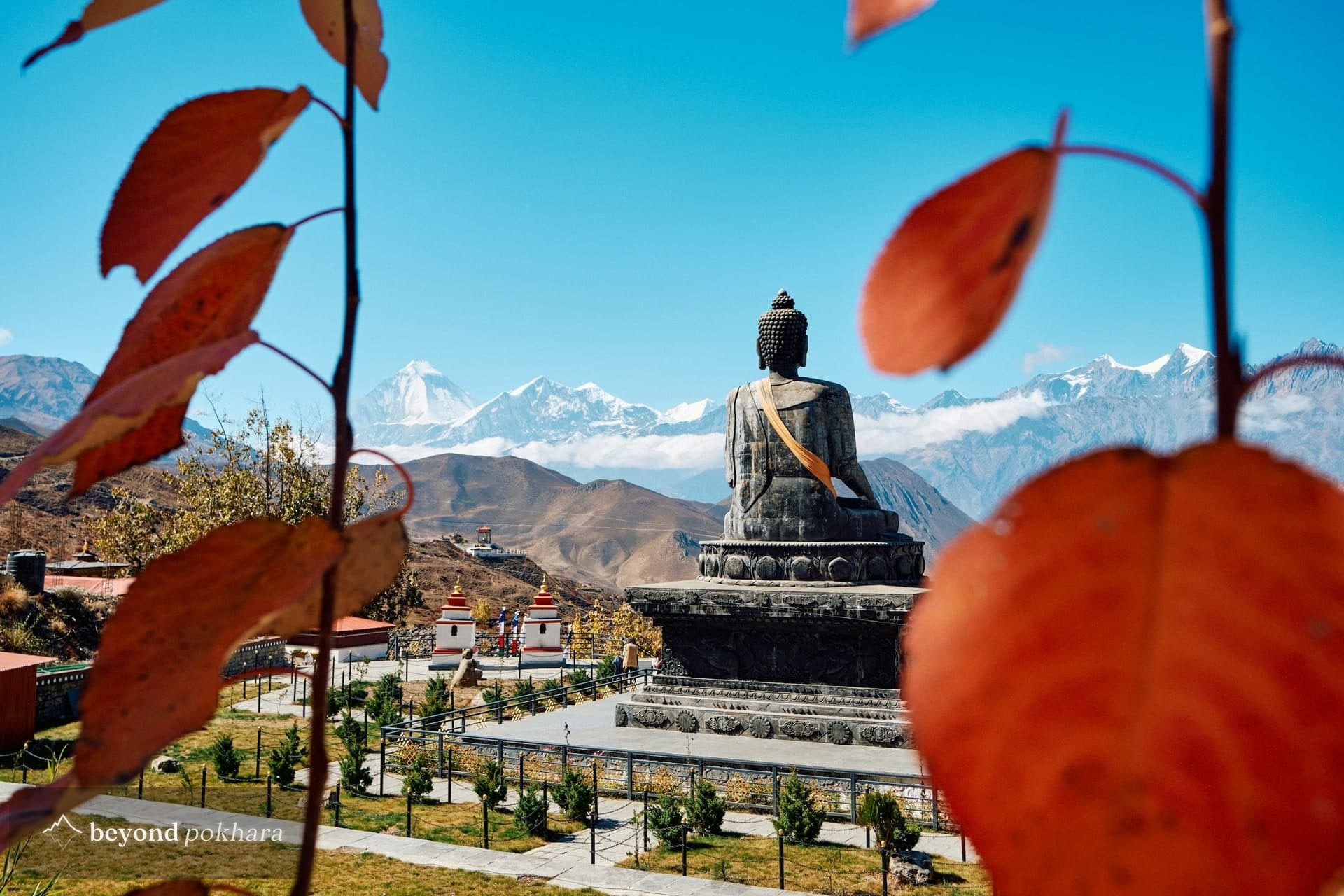
From the parking area in Ranipauwa it is a short, steep walk up stone steps to the temple compound. The main shrine is surrounded by 108 water spouts, and pilgrims walk under each one before dipping in the two small pools in front of the temple. Nearby, the Jwala Mai temple shelters a small natural gas flame burning beside a spring. Buddhists know the site as Chumig Gyatsa, and you will see prayer flags and a monastery alongside the Hindu shrines. A large Buddha statue looks south toward the snow peaks from the slope below.
Dress modestly and take your shoes off where the signs ask. If you plan to walk under the water spouts, bring a towel, because the water is very cold.
How we arrange it
Our trip follows the three-day shape above, with a private vehicle suited to mountain roads and a driver who knows the gorge. A licensed guide travels with you, and we book lodges in Jomsom and Marpha and arrange the permits through a registered agency before you leave Pokhara. The trip is private to your group, from two to six travellers, so you set the pace and the stops. It starts at 299 US dollars per person. That is the starting price, and we confirm the final figure for your group size and dates when you book.
If you would rather hire the vehicle on its own, a 4WD jeep with driver from Pokhara starts around 110 US dollars a day, and the Pokhara to Muktinath route page shows the options. Our guide to car rental in Pokhara covers how vehicle hire works more generally.
In October and November, book a couple of weeks ahead. At other times a few days is usually enough. You can plan the Muktinath trip around your dates in a few taps, or browse our other Pokhara tours.
FAQ
How long does it take to drive from Pokhara to Muktinath?
Around eight to nine hours from Pokhara to Jomsom, then another hour and a half to two hours up to Muktinath. Almost everyone splits it with a night in Jomsom, and three days is the shortest comfortable round trip.
How much is a jeep from Pokhara to Muktinath?
A private 4WD jeep is priced by the day, not by the seat. Ours starts around 110 US dollars a day with driver and fuel, so a three-day round trip is roughly 330 US dollars for the vehicle, shared by up to six people. Our guided overland tour starts at 299 US dollars per person and adds a licensed guide, lodges and permits.
Do I need a permit to visit Muktinath?
Yes. Muktinath is inside the Annapurna Conservation Area, so you need an ACAP permit, NPR 3,000 for foreign visitors and NPR 1,000 for SAARC nationals. You do not need the Upper Mustang restricted-area permit unless you go north of Kagbeni.
Will I get altitude sickness at Muktinath?
The temple sits at about 3,710 m, high enough for headaches if you rush. Sleeping lower, in Jomsom or Marpha at around 2,700 m, and visiting the temple as a day trip keeps the risk low. If symptoms get worse, go down.