A Lumbini pilgrimage from Pokhara is a road trip south, out of the hills and down to the Terai plain near the Indian border, where Queen Maya Devi gave birth to Siddhartha Gautama around 2,600 years ago. The site is now a UNESCO World Heritage garden: the Maya Devi temple built over the birthplace, the pond where she is said to have bathed, a pillar left by the emperor Ashoka, and a long monastic zone where Buddhist countries have each built a temple. From Pokhara it takes five to six hours by road, and it deserves two nights.
Most Lumbini advice assumes you start in Kathmandu or cross from India. From the lake the road is a different one, and the time it takes decides how many nights you need.
The road from Pokhara to Lumbini
The route runs down the Siddhartha Highway, around 185 kilometres. You leave the Pokhara valley heading south through Syangja and Waling, drop to the Kali Gandaki at Ramdi, and climb again to Tansen, the old hill town of Palpa district. After Tansen the road winds down through the Siddhababa section to Butwal, where the hills stop all at once and the flat, hot Terai begins. From Butwal it is a short, straight run through Bhairahawa to Lumbini.
Five to six hours is the honest figure for a private car. For most of its length it is a narrow mountain road shared with trucks, and the bends keep speeds low. The stretch between Tansen and Butwal is the weak point. It is prone to rockfall in heavy rain, and tunnel works at Siddhababa have meant night closures and occasional full-day shutdowns during the monsoon. Outside the rains it is usually just slow.
Tansen is worth more than a tea stop. It sits a little past halfway, three to four hours from Pokhara, with a carved Newar bazaar and a view back to the Himalaya from Srinagar hill. If you have an extra day, sleeping there on the way down turns one long drive into two short ones. Our Tansen and Palpa heritage trip covers the town on its own if you want more time there.
What there is to see at Lumbini
The site is bigger than people expect. The master plan by the Japanese architect Kenzo Tange runs north to south for several kilometres, and you need wheels or a full day on foot to cover it.
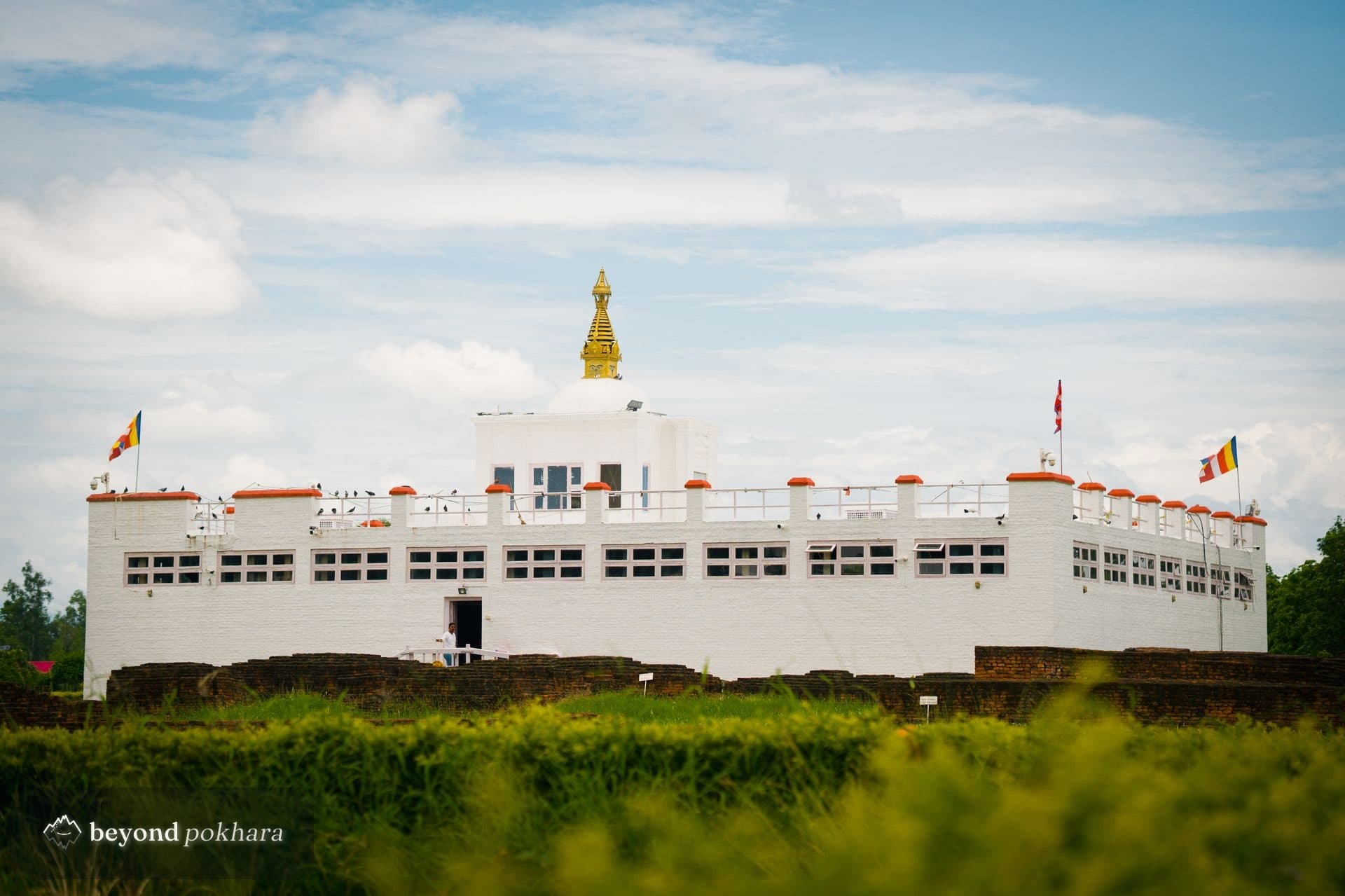
The sacred garden is at the southern end. The Maya Devi temple is a plain white building over excavated brick foundations, and inside, on a raised walkway, you look down at the marker stone for the exact spot of the birth. Outside are the Puskarini pond and the Ashoka pillar, raised when the emperor visited in 249 BCE. Its inscription names Lumbini as the Buddha's birthplace, which is how archaeologists confirmed the site after it was rediscovered in 1896. Monks and pilgrims chant under the bodhi tree beside the pond, which is strung with prayer flags. It is quietest in the first hour after opening.
North of the garden, a long canal splits the monastic zone in two. The west side holds the Mahayana and Vajrayana monasteries, including the German lotus stupa and the Chinese Zhong Hua temple. The east side holds the Theravada ones, among them the Myanmar golden temple and the Royal Thai monastery. Each country built in its own national style, so the Thai monastery looks nothing like the German stupa across the canal. At the far northern end sit the Lumbini Museum and the white World Peace Pagoda, built by Japanese monks.
A bicycle costs a couple of hundred rupees a day. Cycle rickshaws do an inner monastery loop in three or four hours. On our trip a guide and local transport handle it, with short walks between stops.
If you have a spare half day, Tilaurakot sits under an hour west in Kapilvastu. It holds the ruins of the Shakya palace where Siddhartha grew up before he left home, and it gets a fraction of Lumbini's visitors.
How many nights you need
Two nights is the right shape from Pokhara. Day one is the drive, arriving in the afternoon. Day two is the whole day at the site, starting at the sacred garden early and working north through the monasteries as the heat builds. Day three is a quiet morning, the museum if you missed it, then the road home. That is exactly how our Lumbini pilgrimage tour runs.
A day trip is possible and we do not recommend it. Eleven or twelve hours of driving leaves an hour or two at the garden, in the middle of the day, when it is hottest and busiest. One night works if you are short on time, but you trade the monastic zone for the drive.
Lumbini also pairs well with Chitwan. Chitwan sits four to five hours east across the Terai, so a single loop from Pokhara covers the jungle and the Buddha's birthplace without doubling back into the hills. Our Chitwan and Lumbini tour does it in five days, and our Chitwan jungle safari from Pokhara guide covers the jungle half in detail. Travellers flying home via Kathmandu can also end the trip at Gautam Buddha International Airport in Bhairahawa, about half an hour from Lumbini, and fly out instead of driving back north.
What a Lumbini trip costs
The site itself is cheap. Foreign visitors buy one ticket from the Lumbini Development Trust that covers the sacred garden and the Maya Devi temple. It was recently about 500 rupees, a few US dollars, though the trust revises it and some guides still quote older figures. SAARC nationals pay less, Nepali citizens enter free, and you can pay in cash or by QR code at the counter.
The real costs are transport and the room. A tourist bus from Pokhara to Bhairahawa is the budget option at roughly 10 to 15 US dollars a seat, and it is slow. A private car costs more and stops where you want, including Tansen. Our Pokhara to Lumbini route page covers the vehicles for that drive, and our car rental in Pokhara works the same way for any other road trip in Nepal. Rooms run from plain guesthouses in Lumbini Bazaar to quieter hotels near the monastic zone.
Our three-day Lumbini tour starts from around 299 US dollars per person, with the road transfer, two nights of accommodation, a local guide, transport around the site, and entry fees included. Meals are left to you.
The best time to go
October to March. The monsoon is over, the air is dry, and days sit in the low to mid twenties Celsius. October and November are the clearest, with the hills sharp on the drive down. December and January are cool, and thick morning fog can sit over the Terai until late morning.
April to June is the hard season. The plains regularly pass 40 degrees before the monsoon, and the sacred garden has almost no shade. If you go then, be at the gate at opening and back in the hotel by noon. The monsoon runs June to September, and its heavy rain is what closes the road above Butwal. Our guide to the best time to visit Nepal sets Lumbini against the rest of the country, season by season.
Buddha Jayanti, the Buddha's birthday, falls on the full moon of Baisakh in April or May. Lumbini fills with pilgrims from across Asia and rooms go fast. Book well ahead if you want to be there for it, and expect crowds and heat.
Visiting respectfully
People come to Lumbini to pray, and the rules follow from that. Cover your shoulders and knees. Take your shoes off before entering the Maya Devi temple, and keep your camera away inside, where photography is banned. Walk clockwise around stupas and shrines, don't climb on the ruins, and keep your voice down near monks who are meditating. Security staff inside the temple do enforce the camera ban.
If Lumbini is one part of a longer trip, our Pokhara tours page lists the treks and day trips that fit around it.
FAQ
How far is Lumbini from Pokhara?
Around 185 kilometres by road, south down the Siddhartha Highway through Syangja, Tansen, and Butwal. Plan on five to six hours in a private vehicle and longer on a tourist bus. Monsoon rain and roadworks on the Siddhababa section above Butwal can add time.
Can you do Lumbini as a day trip from Pokhara?
You can, but it is a poor trade. The round trip is eleven or twelve hours of driving, which leaves an hour or two at the sacred garden in the midday heat. Two nights in Lumbini gives you one full, unhurried day at the site.
What is the entry fee for the Maya Devi temple?
Foreign visitors buy one ticket from the Lumbini Development Trust that covers the sacred garden and the Maya Devi temple, recently around 500 Nepali rupees, a few US dollars. SAARC nationals pay less and Nepali citizens enter free. The trust revises the fee from time to time, so check it at the gate. On a booked tour it is already included.
What should I wear to Lumbini?
Cover your shoulders and knees, and wear shoes you can slip off, because you walk barefoot inside the Maya Devi temple. Photography is not allowed inside the temple itself. A hat and water matter more than people expect, since the garden has little shade.