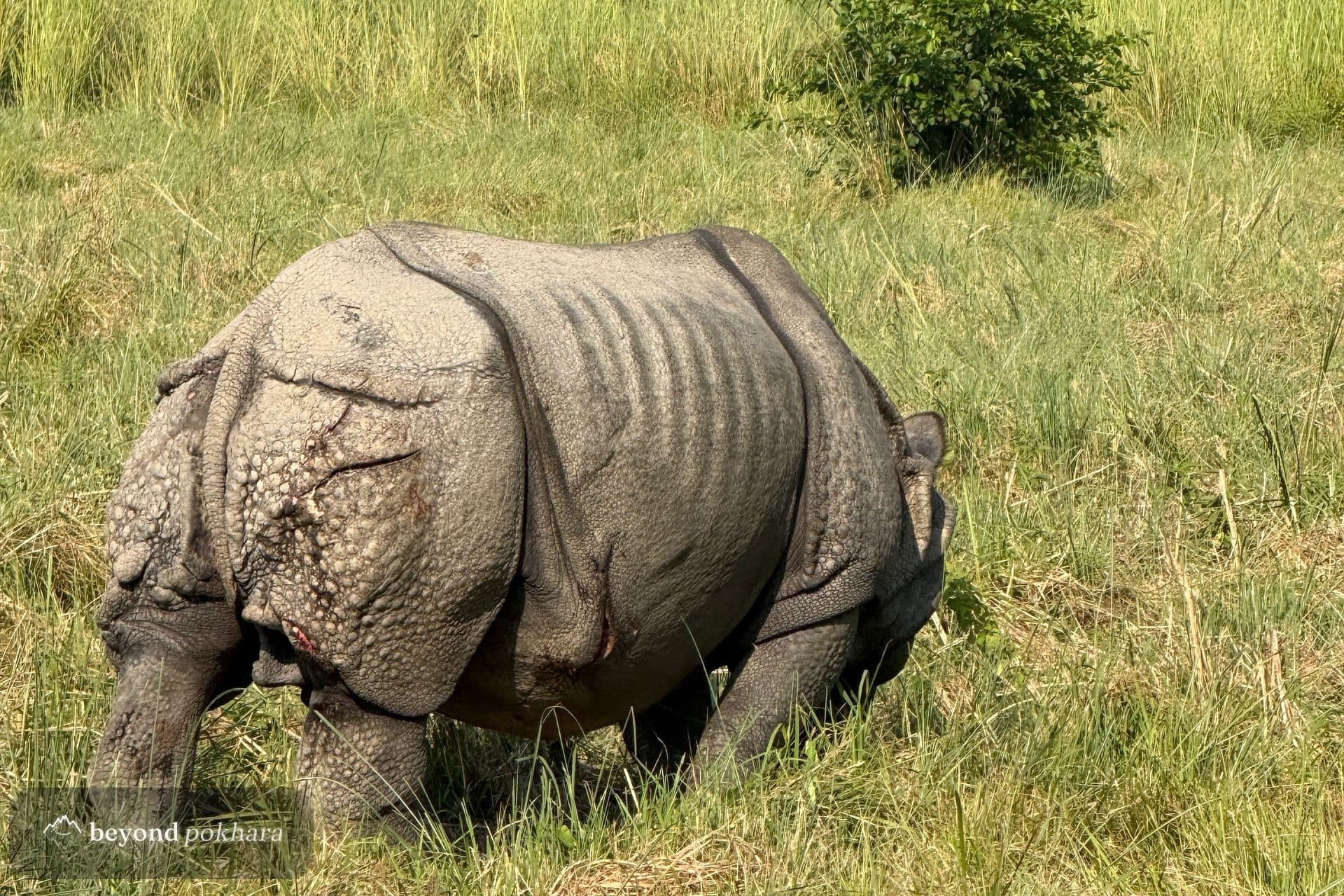
A Chitwan jungle safari from Pokhara takes you off the mountains and down into the Terai, the flat lowland belt along the Indian border where the wildlife lives. Chitwan National Park holds one of the healthiest populations of one-horned rhino in Asia, along with crocodile, deer, more than 500 species of bird, and a small, elusive number of Bengal tiger. It is the classic pairing with time in the hills: a few days on foot or on the lakes around Pokhara, then a few in the jungle.
The park sits about 160 kilometres south of Pokhara. You can reach it in a morning by road, spend two nights at a lodge in Sauraha on the edge of the park, and be back before the week is out. This guide covers the shape of the trip, the fees, and the season that gives you the best chance of seeing something.
Where it goes and how long you need
The base for a safari is Sauraha, the small town on the Rapti river that fronts the eastern side of the park. Lodges line the river here, and every park activity runs from this side.
Three days is the sensible shape. Two nights at the lodge give you a full day inside the park with room for a canoe and a jungle walk on top, which one night never allows. Day one is the drive down and an easy afternoon by the river. Day two is the safari proper. Day three is a short morning outing before the road home. Our Chitwan jungle safari runs on exactly that rhythm, with a park-licensed naturalist for every activity.
A typical two-night trip looks like this:
Day one is the road south from Pokhara, arriving around lunch, with an afternoon walk through a Tharu village and sunset on the Rapti. Day two is the long day: a jeep safari deep into the park for rhino and deer, a dugout canoe among the crocodiles and river birds, and a guided walk with a naturalist. Day three is an early birdwatching stroll or a visit to the elephant breeding centre before the drive back up to Pokhara.
What it costs
Two figures matter. There is the fixed cost of the park itself, and there is the cost of running the trip.
The Chitwan National Park entry fee for foreign nationals is about 2,000 Nepali rupees, near 15 US dollars, per person for each day you go in. The permit covers a single day, because you cannot stay overnight inside the park boundary. A safari that enters on two separate days pays the fee twice. SAARC nationals pay less, and Nepali citizens less again.
On top of that sit the activities and the lodge. Booked independently in Sauraha, a half-day shared jeep safari runs around 25 to 45 US dollars per person with the park fee, a canoe trip on the Rapti is 10 to 20, and a guided walk with two naturalists is 15 to 30. Add the room and the meals and the numbers climb.
Our three-day trip starts from around 149 US dollars per person, and that already folds in the road transfer, two nights at the lodge, all the park fees and activities, the naturalist, and meals. The hard floor under any Chitwan price is the park fee and the licensed guide, so a genuine safari is never the cheapest line on a Nepal itinerary. For the wildlife you get, it still reads as fair value.
Permits and the ethical question
Chitwan does not need a trekking permit or a restricted-area document. The only paperwork is the daily park entry ticket, bought at the gate and arranged for you on a booked trip. That is the whole of it.
The question worth settling before you go is elephant rides. For years the standard Chitwan image was tourists on the back of an elephant crashing through the grass. Since 2022 that has fallen away fast. Welfare concerns and pressure from within the tourism trade have pushed most serious lodges to stop offering rides altogether. We do not run them. A jeep and a canoe get you closer to wild animals without a captive one carrying you, and a visit to the elephant breeding centre lets you see the animals without riding them. A lodge that still pushes rides tells you where its priorities sit.
The best time to go
The window is October to March. The monsoon has cleared, the skies are dry, and daytime temperatures sit around 25 degrees, warm but not punishing. As the season runs on, the tall elephant grass dries down and gets shorter, which is the single biggest factor in whether you see anything. Short grass means a rhino in the open instead of a rustle you never resolve.
February to April, after the park cuts and burns the grass, is a quiet secret for sightings. The cover drops to nothing and animals move in the open. The trade-off is rising heat as April turns toward the pre-monsoon. The Terai is warm year round, so this is never a cold-weather trip, but May through September brings real heat, humidity, and afternoon rain that can flood the grasslands and close the canoe.
How to get there from Pokhara
Two ways down. Most people drive. It is roughly 160 kilometres and four to five hours on the road, longer with traffic or roadworks, running east out of Pokhara on the Prithvi Highway and then south along the East-West Highway as the hills flatten into the Terai. You feel the drop: mountain air one minute, sticky lowland heat the next.
How you cover that road is a comfort question, not a route question. A shared tourist bus is the budget option and slow. A private vehicle is faster, stops when you want, and suits a family or a small group, and it is how our car rental in Pokhara works when you want the drive to yourself. Our Pokhara to Chitwan route page covers the transfer in detail, and for planning the wider trip our guide to two days in Pokhara pairs well with a jungle add-on.
The faster option is the air. A short flight from Pokhara to Bharatpur, the town next to the park, cuts the journey to well under half an hour in the air, then a 20-minute drive to the lodge. It costs more and it removes the long road day, which some travellers happily trade for.
FAQ
How long is the drive from Pokhara to Chitwan?
About four to five hours by road, roughly 160 kilometres down the Prithvi Highway and along the East-West Highway into the Terai. Most travellers arrive around lunch on the first day. A short flight from Pokhara to Bharatpur is the faster alternative.
What is the Chitwan National Park entry fee?
The park charges foreign nationals about 2,000 Nepali rupees, near 15 US dollars, per person for each day you enter. The permit is valid for one day only, so a multi-day safari buys a new one for each day inside the park. On a booked trip the fee is already covered.
Will we actually see a rhino or a tiger?
Chitwan has a strong population of one-horned rhino, so sightings are common on a jeep safari or a river canoe. Bengal tiger is a different matter. There are around 120 in the park, but the tall sal forest hides them, so a sighting is rare and never promised.
When is the best time for a Chitwan jungle safari?
October to March, when the skies are clear and daytime temperatures sit near 25 degrees. The dry grass makes animals easier to spot. February to April after the grass is cut and burnt is also very good for sightings. The Terai stays warm through the year.