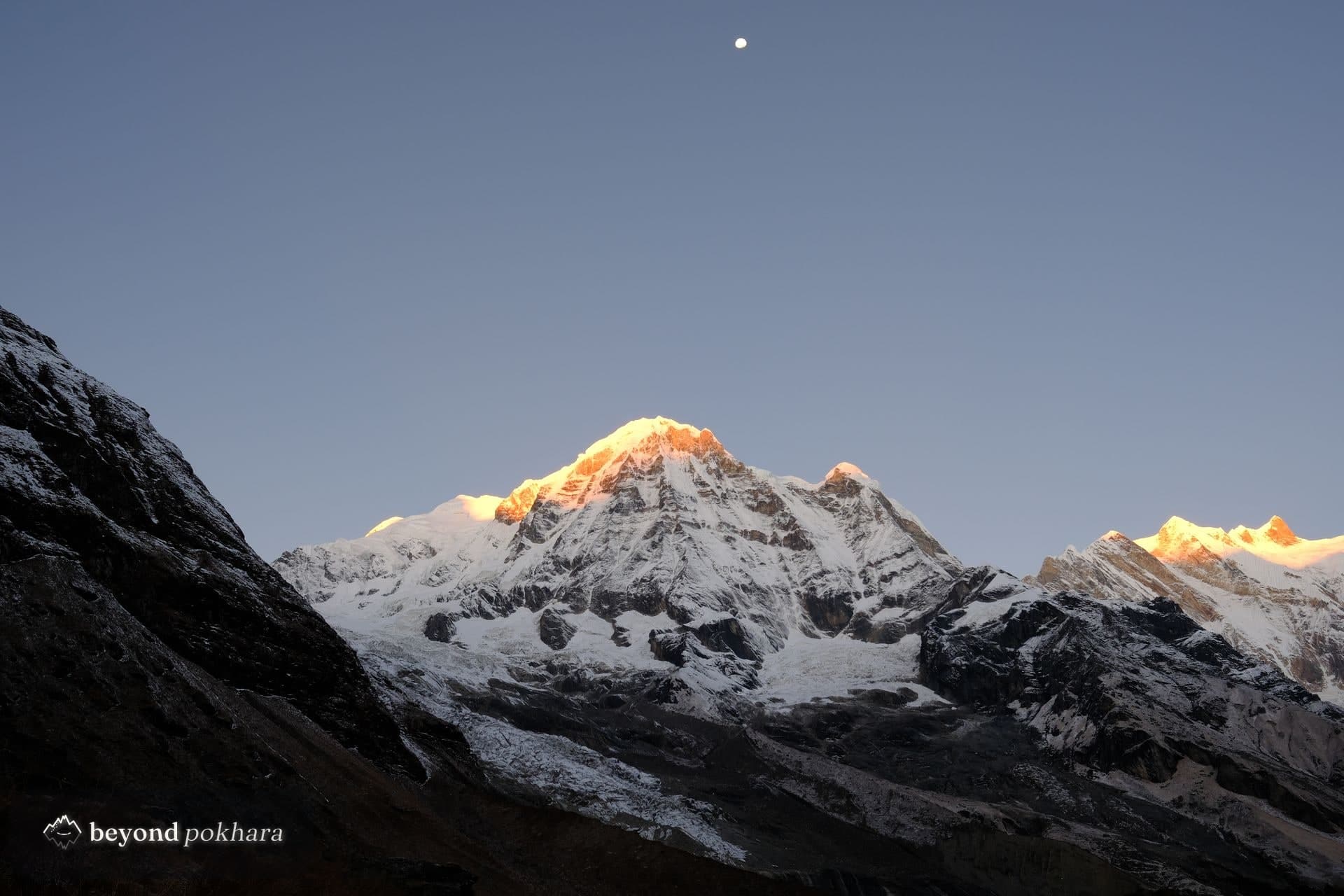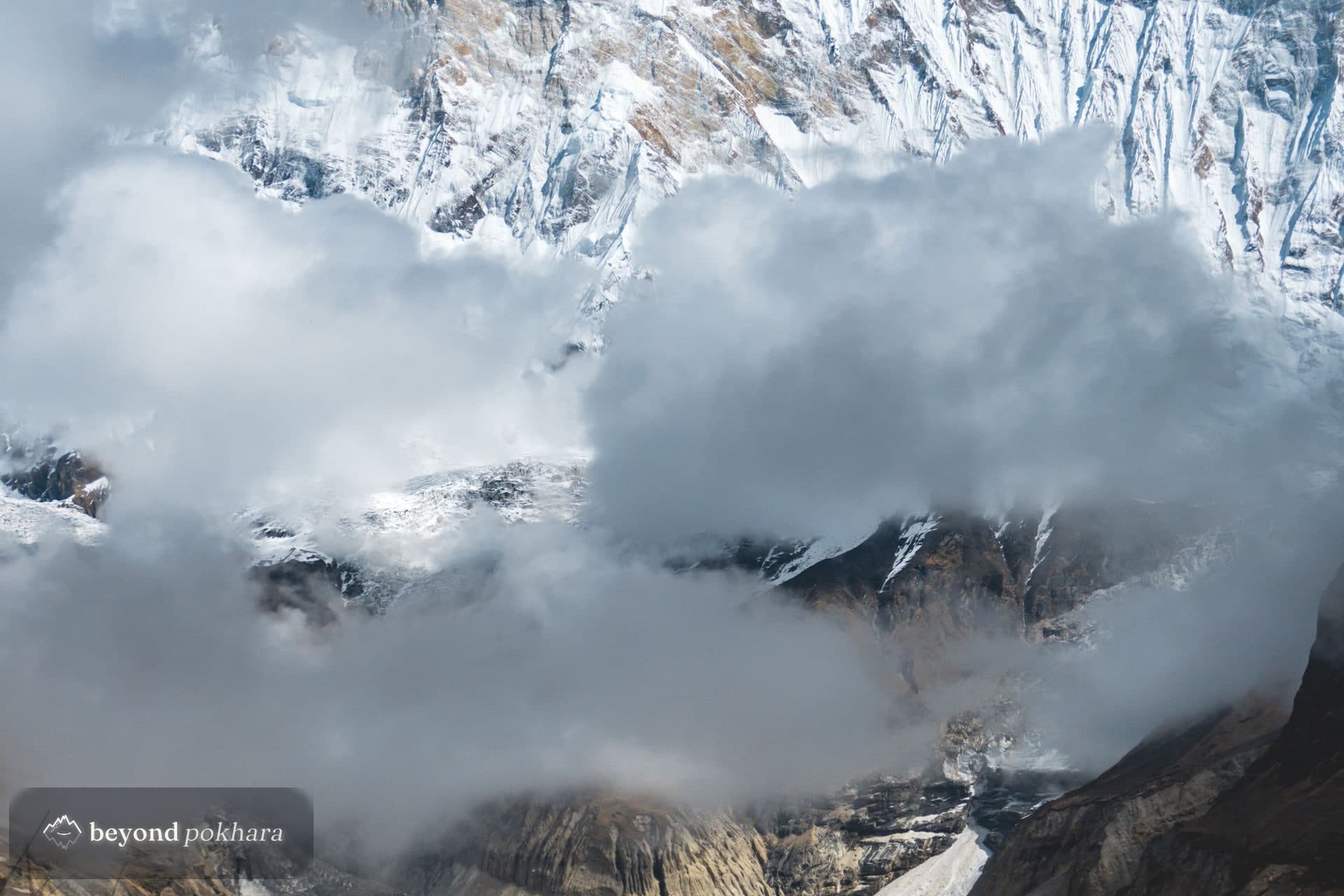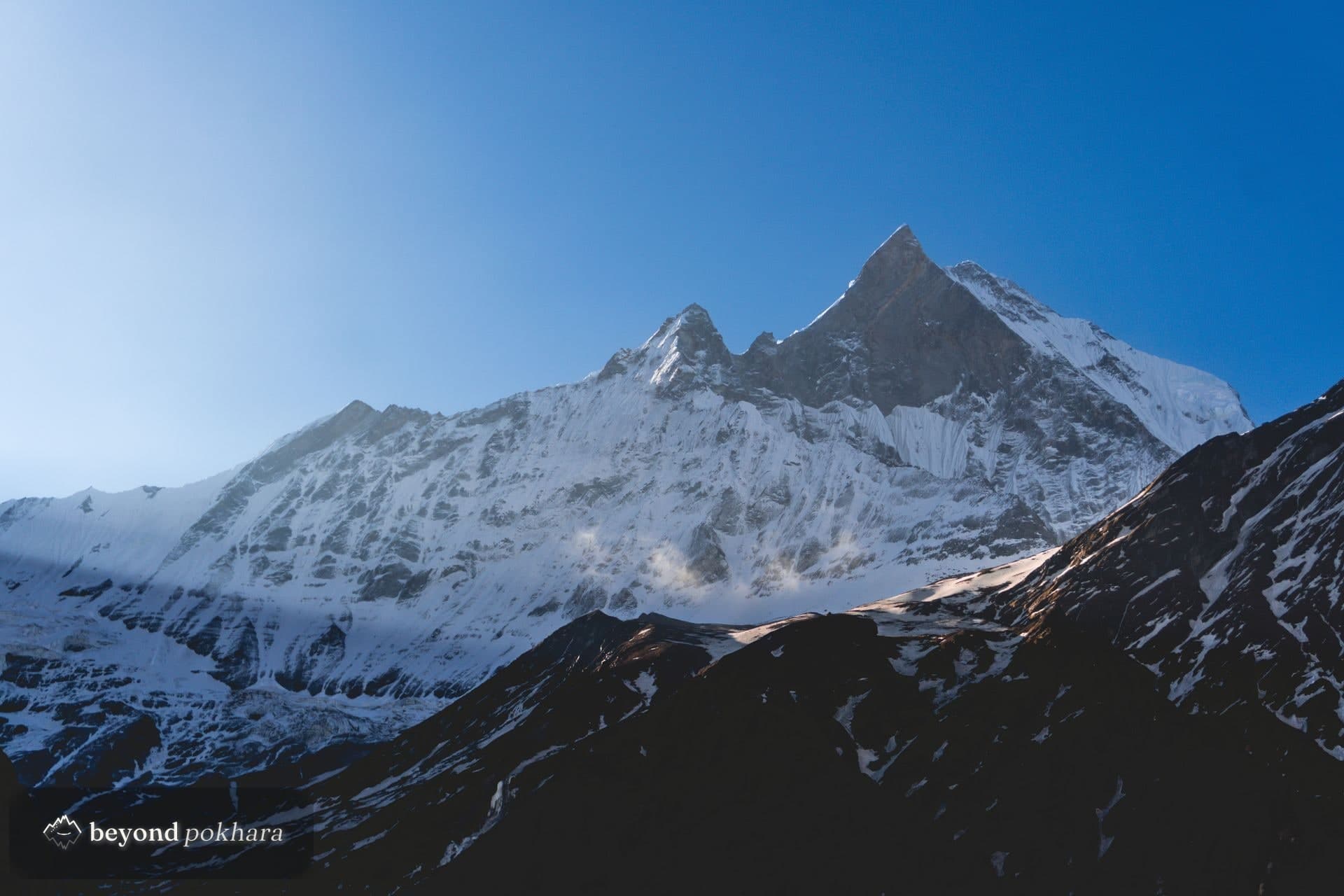
Mardi Himal is the trek people take when they have already heard about the crowds on the bigger Annapurna routes and want something quieter. It sits on a ridge directly under the south face of Machapuchare, and for most of the walk you have that wall of rock and ice in front of you.
It is short, it starts close to Pokhara, and it does not need much in the way of logistics. That makes it one of the best first treks in Nepal, and a good step up from Poon Hill for anyone who wants a little more height and a lot less company.
Where it goes
The trail leaves the road at Kande, climbs through forest to a series of camps along the ridge, and finishes at the Mardi Himal viewpoint at around 4,200 metres. You climb one ridge and come down the far side to Sidhing, so there is a little variety rather than a straight out-and-back. Over five days you cover close to 40 kilometres, on forest trail low down and open ridgeline once you are above the treeline.
Getting there from Pokhara
The trailhead at Kande is about a one-hour drive from Pokhara, and the trek comes out at Lwang on the far side for the drive back. Both transfers are part of a guided trip. If you want to understand the road side of it, our vehicle hire page covers the options, but on the trek the transport is already arranged.
Best time to go
The two clear windows are October to early December and March to May. Autumn gives you the most stable skies. Spring trades a little haze for rhododendron in flower through the forest sections. Winter is walkable but the high camp gets cold and snow can close the top. The monsoon from June to September is green but wet, and the views mostly disappear.
How hard is it
Moderate. The forest days are steep but shaded, and the ridge days above the trees are shorter but more exposed to wind and sun. The high camp to viewpoint stretch is the hard part, early and cold, climbing to 4,200 metres before the long descent off the back of the ridge. There is no serious altitude problem at these heights, but the last morning is a real effort. A reasonable level of fitness and a willingness to walk five to seven hours matters more than past trekking.
How many days
Five days is the comfortable version, and the one we run.
- Day one: drive to Kande, walk to Forest Camp
- Day two: Forest Camp to Low Camp
- Day three: Low Camp to High Camp
- Day four: early climb to the 4,200 m viewpoint, then a long descent to Sidhing
- Day five: short walk to the road at Lwang, then drive back to Pokhara
Fit walkers who want to save a day can compress it to four with a longer final push, but the five-day pace leaves room for weather at the top.
Permits you need
You need the Annapurna Conservation Area Permit, NPR 3,000 or about 22 US dollars, and the TIMS card, NPR 2,000 or about 15 US dollars per person. Since April 2023 a licensed guide is also required for trekking in this area, so a guide is part of any Mardi Himal trip. We arrange the permits and the guide before you reach the trail.
What it costs
Guided, from around 299 US dollars per person, depending on group size and season. That covers your guide, both permits, transport from Pokhara, and teahouse accommodation. A larger group shares the guide and transport, so the per-person price comes down. The full Mardi Himal trek page lists what is included.
What to pack
The kit is the same as any teahouse trek. Broken-in walking shoes, a warm layer and a windproof for the exposed ridge and the cold viewpoint morning, a head torch for the early start, and a light day pack. The high camp is genuinely cold once the sun is down, so a warmer layer is worth the space from November onward.
What it is actually like
The forest days are steep but shaded, and you rarely see the mountains until you break out onto the ridge. Once you are up there the walking opens up and the scenery does the work, with Machapuchare growing in front of you all day. The high camp to viewpoint stretch is the hard part, early and cold, but it is also where the whole range lines up. Most people are back at the high camp for a late breakfast before the descent.