The Annapurna Base Camp trek itinerary runs seven days from Pokhara, climbing from warm river villages to a glacial amphitheatre at 4,130 metres. This is the day-by-day version most people walk: where you sleep each night, how far you cover, how much you climb, and where the hard days sit. It is one of the classic treks in Nepal, and it starts and ends right here in Pokhara.
The route below carries the real distances and altitudes from the trail, not round numbers. If you want the money side instead, the Annapurna Base Camp trek cost guide breaks that down separately.
The route at a glance
- Length: 7 days on the standard shape, trailhead to trailhead from Pokhara.
- Highest point: Annapurna Base Camp, 4,130 m.
- Walking: roughly 60 to 70 km on foot over the week, with a couple of long days.
- Difficulty: challenging. Long days and real altitude at the top, though no technical climbing.
- Best months: October to November and March to April.
The trek is an out-and-back up the Modi Khola gorge, so you return along much of the same trail you walked in on. The one loop is the return through Jhinu, where the riverside hot springs make the last full day worth it.
Day by day
Day 1: Pokhara to Chhomrong
A morning drive from Pokhara to the trailhead beyond Kyumi, then a walk up to Chhomrong, the stone village that guards the entrance to the Sanctuary. About 8 km on foot, four to five hours, ending near 2,170 m. Chhomrong looks straight across at Machapuchare, so the first proper mountain view comes on the first evening.
Day 2: Chhomrong to Dovan
The day starts with a long flight of stone steps down to the river, which you pay back with a climb up the far side. From there the trail follows the gorge through bamboo and rhododendron forest to the lodges at Dovan, around 2,600 m. It is 13 km and six to seven hours, the longest day on the way in.
Day 3: Dovan to Deurali
A steadier day, climbing deeper into the narrowing gorge past the small settlement of Himalaya to the high lodges at Deurali, 3,230 m, just below the gate into the Sanctuary. Around 9 km and four to five hours. You feel the air thinning by the end of it.
Day 4: Deurali to Annapurna Base Camp
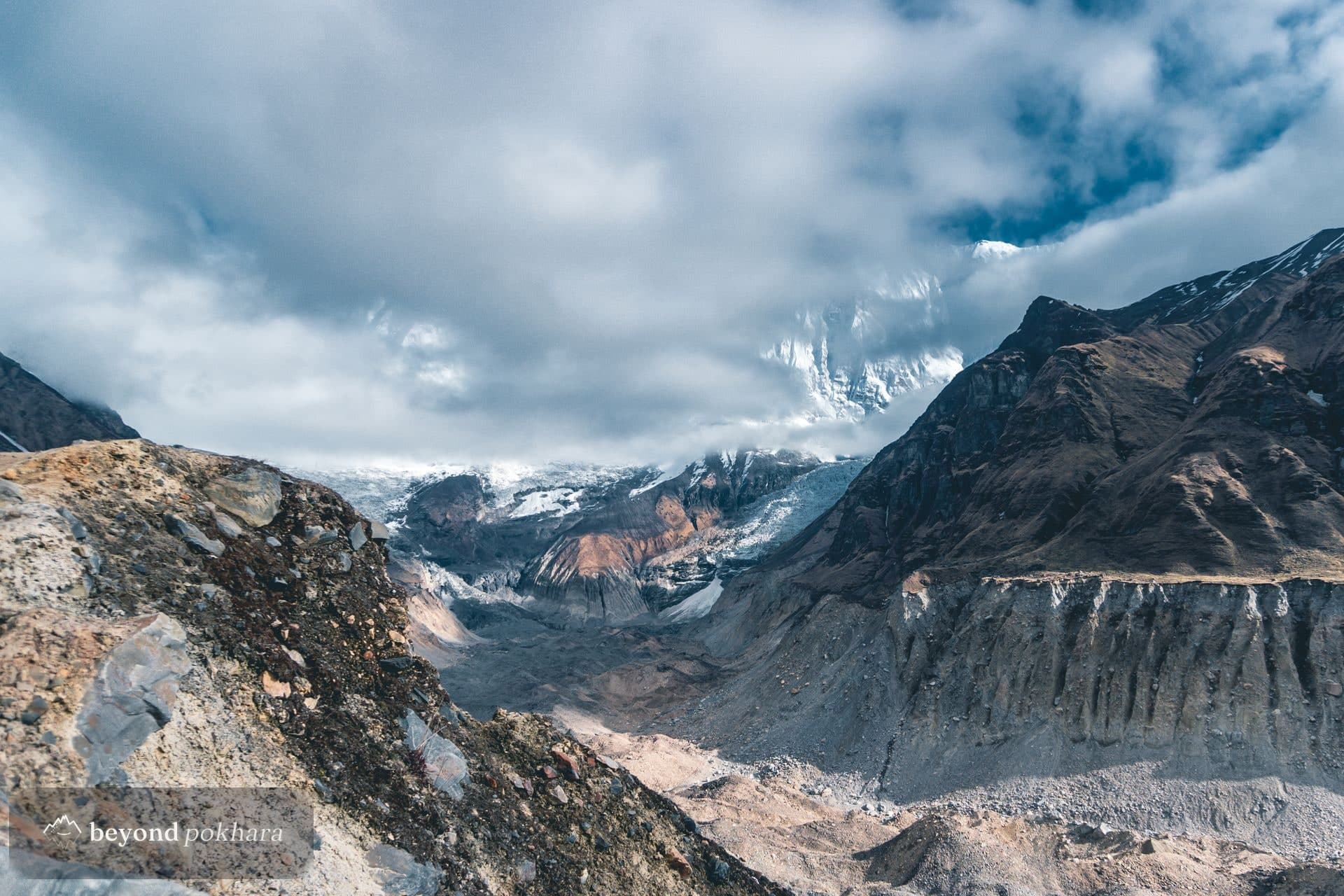
The day it all opens up. The trail passes Machapuchare Base Camp and then into the Sanctuary itself, a bowl of ice and rock ringed almost the whole way round by peaks over seven thousand metres. You reach Annapurna Base Camp at 4,130 m by early afternoon, which leaves time to rest before the cold comes down. About 9 km, four to five hours.
Day 5: Sunrise at base camp, down to Bamboo
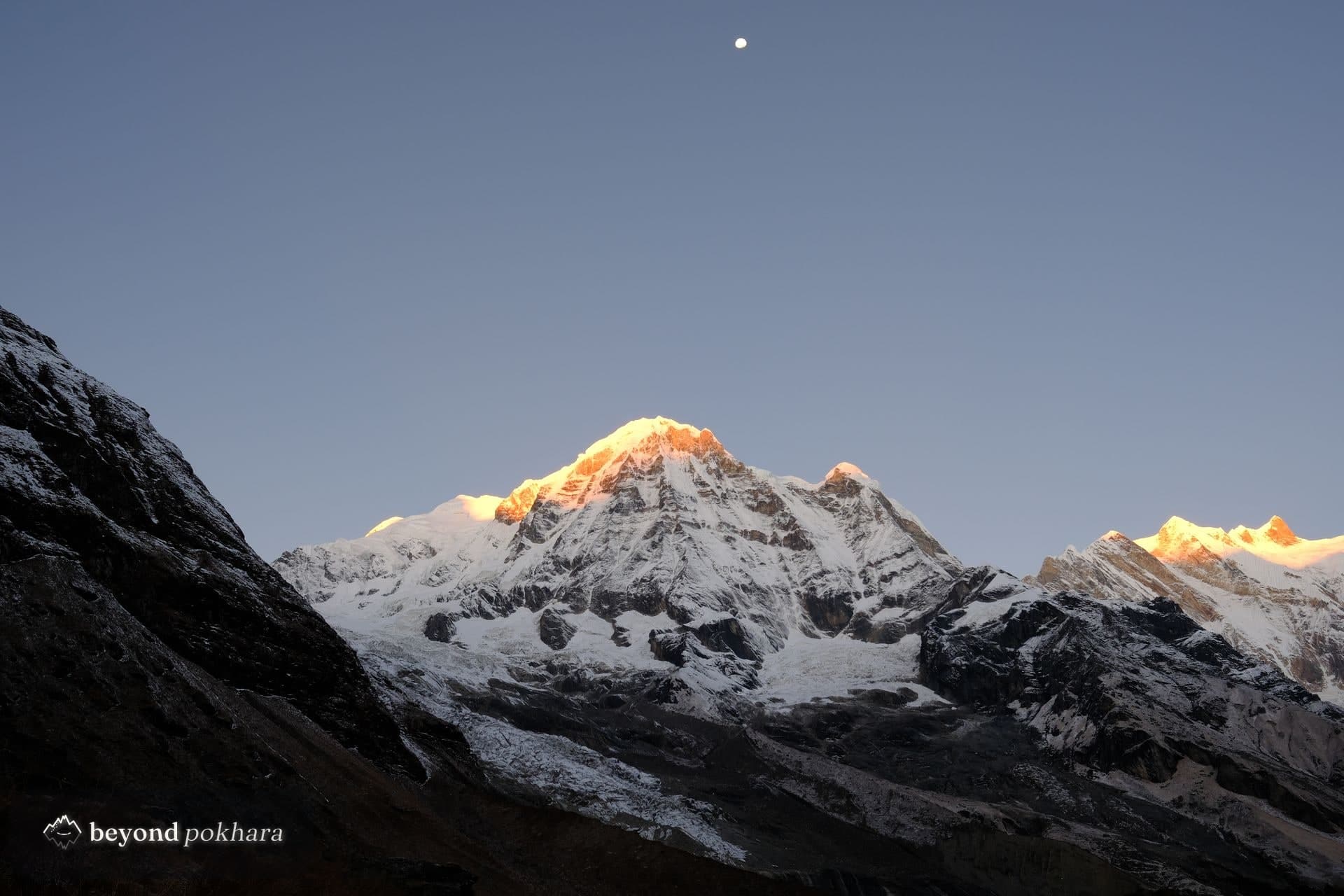
Wake for dawn, when the first light fills the amphitheatre and lands on Annapurna I above you. Then a long descent back down the gorge to the lodges at Bamboo, losing most of the height you spent three days gaining. It is 16 km and six to seven hours, the biggest day of the trek on tired legs.
Day 6: Bamboo to Jhinu hot springs
Back up the steps to Chhomrong, then down the other side to Jhinu Danda at 1,780 m. The reward is a short walk below the village to the hot springs on the bank of the Modi Khola, an evening soak that the week has earned. Around 11 km, five to six hours.
Day 7: Out to Pokhara
A short walk down to the road at New Bridge, about 5 km and a couple of hours, then the drive back to the lake. You are usually in Pokhara by the afternoon with the trek behind you.
That is the 7-day shape. It flexes both ways. Fit walkers short on time can drive in higher and do it in five or six days. If you would rather ease into the altitude, add a night, or add Ghorepani and the Poon Hill sunrise on the front for a nine or ten day loop. The full route and the ways to run it sit on the Annapurna Base Camp trek page.
How hard is it
Harder than Poon Hill, and a step up from the shorter foothill walks. There is no climbing or technical ground, but the days are long, the descents are hard on the knees, and the top sits high enough that most people feel the altitude. The climb is gradual enough to acclimatise on the standard seven days, which is one reason we do not rush it. If you have not trekked at altitude before, the Poon Hill trek is a gentler first taste of the same region.
Permits you need
Two documents cover the walk, and a guided trip includes both:
- ACAP (Annapurna Conservation Area Permit): NPR 3,000 for foreign trekkers, less for SAARC nationals. Checked at posts along the trail, so you carry a printed copy.
- TIMS card (Trekkers' Information Management System): NPR 2,000 for foreign trekkers. Enforcement on the Annapurna trails comes and goes, but it is simplest to hold one.
Both are arranged for you when you book the trek, so there is nothing to queue for in Pokhara. If you want the detail on how permits and the rest add up, the Annapurna Base Camp trek cost guide covers it.
Best time to walk it
Two windows stand out. October to November brings the clearest skies and the driest trail of the year, with cold but settled nights at base camp. March to April is the other strong window, a little warmer lower down and with the rhododendron forests in flower through the gorge.
The monsoon, June to August, means rain, leeches, and cloud that hides the peaks you came for. Deep winter is walkable on the standard route but very cold at the top, and some high lodges thin out. For a first trip, aim for autumn or spring.
What it costs
A guided Annapurna Base Camp trek from Pokhara starts from around 499 US dollars per person, with the final figure set by group size, season, and whether you add a porter. That covers the guide, permits, transport from Pokhara to the trailhead, and teahouse nights. Meals on the trail sit on top. The full breakdown, including what changes the price, is in the Annapurna Base Camp trek cost guide.
How to get there
Everything begins in Pokhara. We drive you from the lake to the trailhead beyond Kyumi on the first morning, about two to three hours by road, and collect you at New Bridge on the last day. If you are still deciding how to reach Pokhara or want a vehicle for the wider trip, our vehicle hire in Pokhara covers airport transfers and point-to-point drives with a local driver. Pokhara itself is the natural base for treks across this part of Nepal, so most people build a day or two by the lake around the walk.
FAQ
How many days is the Annapurna Base Camp trek?
Seven days on the standard itinerary from Pokhara, trailhead to trailhead. Fit walkers can compress it to five or six by driving in higher, and adding Poon Hill on the front stretches it to nine or ten.
Do I need trekking experience for Annapurna Base Camp?
It helps but is not required. The trek is challenging rather than technical, so a reasonable level of fitness and a willingness to walk long days matters more than past trekking. The seven-day pace is set to acclimatise steadily.
What is the highest point on the trek?
Annapurna Base Camp itself, at 4,130 m. You spend one night there and wake for sunrise before starting the descent.
Can I combine it with Poon Hill?
Yes. Adding Ghorepani and the Poon Hill sunrise on the front makes it a nine to ten day loop and eases you into the altitude. It is a popular way to see more of the Annapurna foothills in one trip from Pokhara.